Showing posts with label airplanes. Show all posts

Sunday, 6 August 2017

AirAsia Cadet Pilot Programme 2017 : Experience Sharing

A very good day to all reading. A friend of mine has just recently completed all the stages of his AirAsia cadet pilot programme of 2017. Hence, I thought it would greatly benefit others who are anxious to know about the whole process from start to finish and what goes on behind it. As updated resources and articles from blogs are few and scarce, I am very grateful that my friend has accepted my invitation to write for this humble blog, sharing the same hopes that this will encourage, inspire and in due course, prepare the next batch. Happy reading.

P.S. - It's long. But if you're truly interested, it won't matter, wouldn't it?


"I'm a candidate of the AirAsia Cadet Programme Year 2017 and have just completed my SPM last year. It's a golden opportunity for those who dream to soar the skies when AirAsia announced their cadet pilot programme opening. As an SPM leaver without having any hesitations, I directly applied for the programme on the day my SPM results were released. Soon after that, I was glad to get an invitation of STAGE 1-Entrance Exam a month before sitting for the assessment. The assessments of this year were basically still the same as the previous year. Now I’m going to share in detail all of the processes I’ve gone through.

In Stage 1, we'll be assessed in 3 SPM-syllabus based subjects namely English, Maths and Physics. All papers were in the form of Multi Choice Questions (MCQ). English paper's standard was slightly more advanced than SPM and it was similar to MUET standard. Without any doubt, I just kept practicing by doing MUET Paper 3 as much as I could, although I knew that I was just an ordinary SPM leaver. Remember what Sir Tony Fernandes has said, "DREAM THE IMPOSSIBLE, BELIEVE THE UNBELIEVABLE and NEVER TAKE NO FOR AN ANSWER." Bear in mind, we weren't allowed to use any calculator for MATHS paper. But non-programmable scientific calculators were allowed to be used in PHYSICS paper. Physics paper was okay for me because it was more to SPM syllabus. Please do not just pick a chapter of SPM Physics which is related to aviation to study, TRUST ME the questions asked in the exam covered all the chapters. Do practice lots and lots of SPM past year questions especially for Maths and Physics until you get familiar, by then you should be able to ace the exam. The most important thing for this first stage is to focus as much as you can in doing your preparations as those efforts will pay off.

Surprisingly, I got my invitation email for Stage 2- Harrison assessment after 2 weeks. The Harrison assessment is a personality test assessing our characteristics whether or not we are suitable to become a pilot. Firstly, I was assisted by a HR lady in logging into the test, so there shouldn't be any problem. Always listen to instructions from the HR people during the assessment. Well, in this test, there are at least 8 statements in each question. Eg. I like outdoor activities, I don't mind sitting for a long time, etc. You will need to drag the statements according to your personality, the one you put at the top describes you the most while the one you put at the bottom describes you the least/not at all. Don't arrange the statements as how a pilot is going to arrange, just be yourself when answering. The system itself is able to detect our dishonesty if our answering pattern is not consistent. So, you will be asked to repeat the test again from beginning to ensure consistency. There's no time limit for this test BUT the HR lady told us not to do more than 30 minutes as doing more than that, means you're over-analyzed of yourself and this surely will affect your marks. As there is no wrong and right in this test, you can’t really tell if you did well or not. And once again, BE YOURSELF when answering the test. That's all for stage 2.


And again after 2 weeks, I was very excited to be invited for Stage 3- Face to Face Interview. It was an individual interview instead of a group interview. There were 2 sets of interviewers, so each set would be interviewing ONE candidate at the same time. We had to wait for our turn to be called for interview session. Yes, it was indeed a very nervous period of waiting time. Moreover, I was the last to be interviewed. My interview panel consisted of one captain and 2 HR ladies, thus it was 3 vs 1. As soon as I handed over my documents and certificates to them, I was asked to tell them about myself. They did ask me a CRM question which seemed to be quite hard. Try not to ignore their suggestions though. And, DON'T lie to them and just say you don't know if you have no idea how to answer their questions because they'll know from the way you answer. I was asked about AirAsia, specifically about the background, newest route and board of directors (Who are they? What are their roles in AirAsia?) all in rapid fire. There were a few candidates interviewed earlier who were asked to draw an aircraft on the whiteboard, label the components on the drawing and explain their functions. They might not ask any technical questions at all, but instead ask a lot of questions related to your academic experiences and qualifications (not necessarily related to aviation) if you're a diploma/degree holder. Everyone has their own background, so we would be given questions differently, but still we have to prepare at least for questions regarding the basics of flight. As they know I'm a flightsimmer and did study about the A320, I was asked to visualize the A320 cockpit instruments, what's shown on Primary Flight Display, what are ECAM actions, how do I cope with engine 1 fire etc. I believe they were just interested in your passion towards aviation. My advice is, BE HONEST. Alright, stage 3 done.

After that, I got an email saying I passed the interview and invited to attend Stage 4- QCT and psychomotor test/Final Assessment of AirAsia Cadet Programme 2017. We were given a manual of the psychomotor test and a short briefing on the overall assessment, so technically don't have to worry much. Then, we were split into 2 batches. I was in the first batch going for QCT first while the second batch would be waiting to sit for psychomotor to save time. QCT (Quantitative Critical Thinking) is a computer-based Maths exam to test our quantitative reasoning ability. There were a lot of problem-solving questions related to simultaneous equations (2 to 3 unknowns) and each question had its own time limit depending on the difficulty. They were in the form of multi choice questions (MCQ) and had 8 choices of answers. Once the time limit is reached, you will automatically jump into the next question. So you need solve as fast as you can and not waste any time. Although you have solved the question and still have time left, you can't go back to it right after you've clicked to proceed to next question. Thus, do make use of the remaining time to double check your answer. The system will keep giving you questions until you can’t answer anymore to see how smart you are. And yes, you're allowed to use non-programmable scientific calculator and given A4 papers in this test.

Next, we proceeded into the 2nd part of the assessment which is the psychomotor test to assess our multitasking skill. In this test, you will be facing a monitor with a Logitech Extreme 3D Pro joystick provided, a 3x3 numeric keypad, a headset and a mouse (which you don't actually need). Before the psychomotor test begins, you will have a short trial for practice and familiarization. Okay, let's talk about the tasks.

First task- On the Primary Flight Display (PFD), you have to follow the flight director/crossbar which constantly moves, as close as possible under the conditions of wake turbulence.

Second task- You need to memorize the 5-digit recall numbers displayed at the top of PFD as you will have to key the number in a box which only appears when the PFD freezes. There will be only ONE 5-digit number appearing for about 5 seconds at once. In my session, I had two different numbers appear consecutively so I had to memorize them and input the numbers in sequence. After you've keyed in the recall number, the PFD unfreezes. Note: You can't write down the recall numbers in a paper, you MUST memorize instead. <------ (This is new) 

Third task- You're required to listen to the voice from your headset, continuously calling out a number (range 1-9) with an interval of roughly 5 seconds before the next one is mentioned. When you hear 3 consecutive odd numbers, press on either one of the odd number-labeled buttons on the joystick. If 3 consecutive even numbers, then press on an even number-labeled button on the joystick. There are buttons labeled 1, 2, 3 etc. on the joystick. Try not to miss out any number callout.

Fourth task- You'll see two virtual 3x3 numeric keypads situated beside the PFD, one on the left and right respectively. It's just like a game. Whenever any key of any of the virtual keypads illuminate yellow, you must quickly react by pressing on the corresponding key on your 3x3 number pad to acknowledge. Prolonging the reaction time will affect your result. Only one key will illuminate yellow at once. It's kind of a test to see how fast our reaction is towards a change.

Overall, you have to carry out all the tasks continuously up to 10 minutes. Felt so exhausted after the test but I was grateful to have completed all the assessments of AirAsia Cadet Programme 2017.


Thankfully after everything I’ve gone through, I received an email from AirAsia to prepare for Class 1 Medical test. I've got my Class 1 Medical Certificate and am now waiting for my enrollment into HMA, Langkawi next month. Being a pilot has always been my dream since childhood, it's now getting one step closer towards getting it realized. Invest your efforts into something you dream to achieve in life and the efforts will definitely pay off. They will."

Friday, 4 August 2017

MASWings Cabin Crew Interview Experience

Since there aren't many articles or posts regarding the interview process for MASwings, I decided to write one based on my personal experience having just attended one in Kuching early this year (on 21st Jan). I hope that my experience sharing will benefit future candidates and help them prepare in case they would want to attend a MASwings cabin crew interview in the future.
Before going for the interview, I searched and read articles and blog posts regarding the Malaysia Airlines cabin crew interview process, just to get a rough idea of how it will be for MASwings. It should be pretty similar since MASwings is a subsidiary of Malaysia Airlines Berhad.
The MASwings cabin crew interview that I attended wasn't an open walk-in interview, it was invitation by email. About a month or so before the interview, MASwings posted on their social media that they were recruiting. Interested candidates were instructed to apply online. Only shortlisted candidates would be notified via email. Now this is where you have to make a resume that impresses them. Since they will no doubt be filtering through hundreds of resumes, you want to make sure yours stand out or at least be good enough to be selected. If you have any experiences at all in customer service or even in the F&B industry, list it down! Write in your objective that you really want to give the best service you can to serve not only the airline but also for the passengers of Sabah and Sarawak.
After you've submitted your application, wait for the email. It will take about 2 weeks or more. The closing date for the application was 9th Jan. I submitted my application on the 8th and got the interview invitation email on the 18th. The interview was to be held on the 21st, so only less than 3 days to prepare!
I could tell you, once I received the interview invitation email, I was over the moon. Here’s how the email looked like.


D-day.
Arrived at the interview venue at 0815 and registration was scheduled to start at 0830. Already there were lots of people queuing up. Registration only actually started at 0945. We were brought up to a holding room where we were split into two groups to facilitate the flow as it was getting crowded.
The interview will have 5 stages:
  1. Height and weight check
  2. Document & credentials check
  3. Grooming
  4. Drilling
  5. Final
First stage, height and weight check.
The first stage is where you will see a lot of people start to disappear already. Your height and weight will be measured. After that, your BMI will be calculated on the spot. They were using an online BMI calculator. One person measures the height and weight, one person records it on your application slip and one person calculates the BMI and checks the boxes 'ACCEPTED' or 'REJECTED'. They will be looking for people with an average BMI. Those who are underweight or overweight will have the REJECTED box ticked and will be told 'sorry, you are underweight/overweight and have been rejected. You can try again next time.' And those people will be sent home straight away. My interview had around 130 candidates (if not mistaken). Out of 130++ people, only half or even less than that were left after the first stage. So my advice is if you are scared that you will be sent home at the first stage, calculate your BMI at home first. If you are under or over, don't waste your time. They are quite strict with little or no compromise at all. I calculated by BMI the night before and I got an average BMI so I was good to go.

Second stage, document & credentials check.
The second stage is pretty self-explanatory. They will check that you have the required SPM qualifications, full body photo, passport size photo, photocopy of IC and other necessary credentials. Please make sure to bring both original and photocopy of any documents you bring. Once you have all necessary documents, you will be given an employment application form to be filled up and returned to the desk. Otherwise, you will be sent home. Oh, and always make sure to bring a pen, stapler or glue to any flight attendant interview. They will hand out forms and some of those forms will require you to stick a passport size photo on it. For those with thick folders of qualifications and certificates, please do not bring all of them. If you have certificates related to customer service, first-aid or anything related to the job of a flight attendant then you may bring them. Otherwise please don’t bring folders that look like Yellow Pages. You don’t actually think the appraisers will have time to go through all of them, do you?

Third & fourth stage, grooming and drilling (combined).
The third stage will be the grooming stage. Probably the stage where even more people will be sent home as they are very strict at this stage. The grooming stage will be held at a different room and only 5 people will be called at one time to go down for the grooming stage. 2 will go into the room and the rest will wait outside. Unfortunate to say, this is the stage where I failed and was sent home. While waiting outside, you will be given an evaluation form and they will ask you to fill up your name, IC number and queue number. The rest will be filled by the appraiser (the person who checks/evaluates you.) It is a 5-6 page form. The first page will be the one where you fill in your name etc and the bottom of the page will be the final decision 'ACCEPTED' or 'REJECED' boxes as well as score by the appraiser. The rest of the pages will have sections devoted to almost all parts of the body with boxes under them. Each section will have 3 boxes saying 'YES' 'NO' and 'Reason for non-recommendation'. Beside the third box will be various reasons for non-recommendation. For example the Face section. Beside the third box you will find reasons like 'shape too broad/shape too long' etc. I'll let the pictures below do the talking. 


For my interview, it seemed like the third and fourth stage (grooming and drilling) was combined. For those with pimples and red scars on the face and neck area, I'm so sorry but it's 95% confirmed you will be sent home no matter how stunning you may look all dressed up. For those with braces or crooked teeth, it's the same. It is brutal and you should prepare for the worst.
To prepare for the drilling, (they MIGHT constantly shoot you questions after questions) read up on the role of a flight attendant, do some research on the company background, their fleet, their slogan, their key people etc. Show that you are interested in being apart of the company.
In the room there will be two tables, one at each end. At each table there will be two appraisers. For men wearing long sleeves, they will ask you to roll up your sleeves to check for any visible scarring, birth marks and tattoos. They will then ask you to loosen your tie and unbutton the top button and they will examine your neck area for scars, birthmarks and tattoos. After that they will sit and have a little chat with you. This is where you have to sell yourself. Interest them; make them curious to know more about you. Talk a lot and with confidence. And one important thing, don't forget to SMILE! Smile from the moment you enter the room. Smile all the way. Heck, smile for no reason at all! The longer they keep chatting with you, the better. Because it shows they are interested in you and they want to keep you to know more about you. They will be asking typical interview questions like 'tell me about yourself' or 'describe yourself' and all that.
There will be a crew luggage bag near each table. You will be asked to walk from one end of the room and back while pulling along the bag. Just like a real flight attendant walking through the airport. So stand straight, chest forward, shoulders back and relaxed, eyes all the way forward with a SMILE and walk with confidence! At the end of that, you will be asked to wait outside for your results. Unfortunately mine was 'I'm sorry Mr. Xxx, you have been rejected. You may try again next time.'

Fifth and final stage.
Oh, how I wished I was among the lucky handful to have advanced to this stage. Unfortunately I can’t tell you what the final stage is like. But from a separate blog post detailing Malaysia Airlines cabin crew interview process, the final stage is supposed to be more relaxed. The remaining candidates will be separated into small groups and will be given topics to talk about. And maybe the appraisers will have a casual chat with you just to know you more. I assume it’s the same with MASwings.
So even if I was not successful, I am still very grateful. Because I am one of 130 people who got the invitation email. Most people dream about it but do not get it yet I got it so I am thankful. I am thankful I passed the first 2 stages when so many people were sent home at that stage. I am thankful to have seen the standards they require so I know where I'm lacking and where I can still improve. Overall I'm grateful for the whole experience. For those who are reading this, those who went and are reading this and weren't successful, it's okay. Be thankful for all the little things. I am so thankful to be among the final 20-30 candidates left.
So thank you MASwings for the opportunity and thank you all for spending your time to read this all the way till the end. 

Wednesday, 30 September 2015

Hello Lion City! AK705 KUL-SIN

Continuing on where I left off from the previous report, this is the second sector of my holiday, KUL-SIN.

The haze that night was really bad. Couldn't even see KLIA Tower 1 and the terminal.


After having spent the night at KLIA2 (we didn’t sleep), it was a nice and early morning flight out of Lumpur down to Singapore. The flight time was actually surprisingly very short.


Check in was already done when I was in Kuching and I have printed out the boarding pass for all of us. I find the fact that AirAsia offers various methods to check in to be quite a potential life saver. For example if I lose the physical printed boarding pass I can always reprint the boarding pass by scanning the QR code at the kiosk that I’ve downloaded into my phone.

This sector was quite exciting because we get to use the skybridge to the international pier. Was hoping for aircraft to pass underneath us but it looks like the early morning rush wasn’t in full swing anymore. Our gate was P12 which is at the east end and the last gate of the pier. By the time we reached the gate, it felt like I had been hiking all morning. Or maybe it was just my physical fitness. Heh. 

Malindo territory
We had a slight delay for departure that morning with the scheduled departure time being 8.35am. Boarding began only at 8.15am. Visibility was at 2500m that morning according to the METAR.


There were 3 flight crew in the flight deck that day and equipment used was the fairly new 1.2 year old WiFi equipped 9M-AJQ.

Seat 25F for me. MAB Boeing 738 landing runway 14R.
Pushback commenced at 8.40am for runway 15. Flaps 2 takeoff via Y2 intersection. Taxied via U5 Z Z3 and Y.


Taxied past some of AirAsia X’s big birds and came across 9M-XXF (Visit Malaysia Year livery) at remote bay Q18. I noticed in some recent videos that she has been there for quite some time. Anyone knows what’s gonna happen to her? 

Takeoff roll begun at 8.53am. Video can be found here.


RM9 for 3MB of mobile data. My opinion will be it’s not worth it just for a couple of selfies to post online to let everyone know what you’re doing up in the air. But it would be worth it for some urgent messaging or emails. The descent into Singapore was pretty much like flying blind. There was nothing we could see out the window until we were somewhere over Johor, an indication that we would be seeing nothing much but haze in Singapore too.

Banking right somewhere near Pasir Gudang on one of the LELIB arrival STARs for runway 20R.
Passing Tanjung Langsat Port.
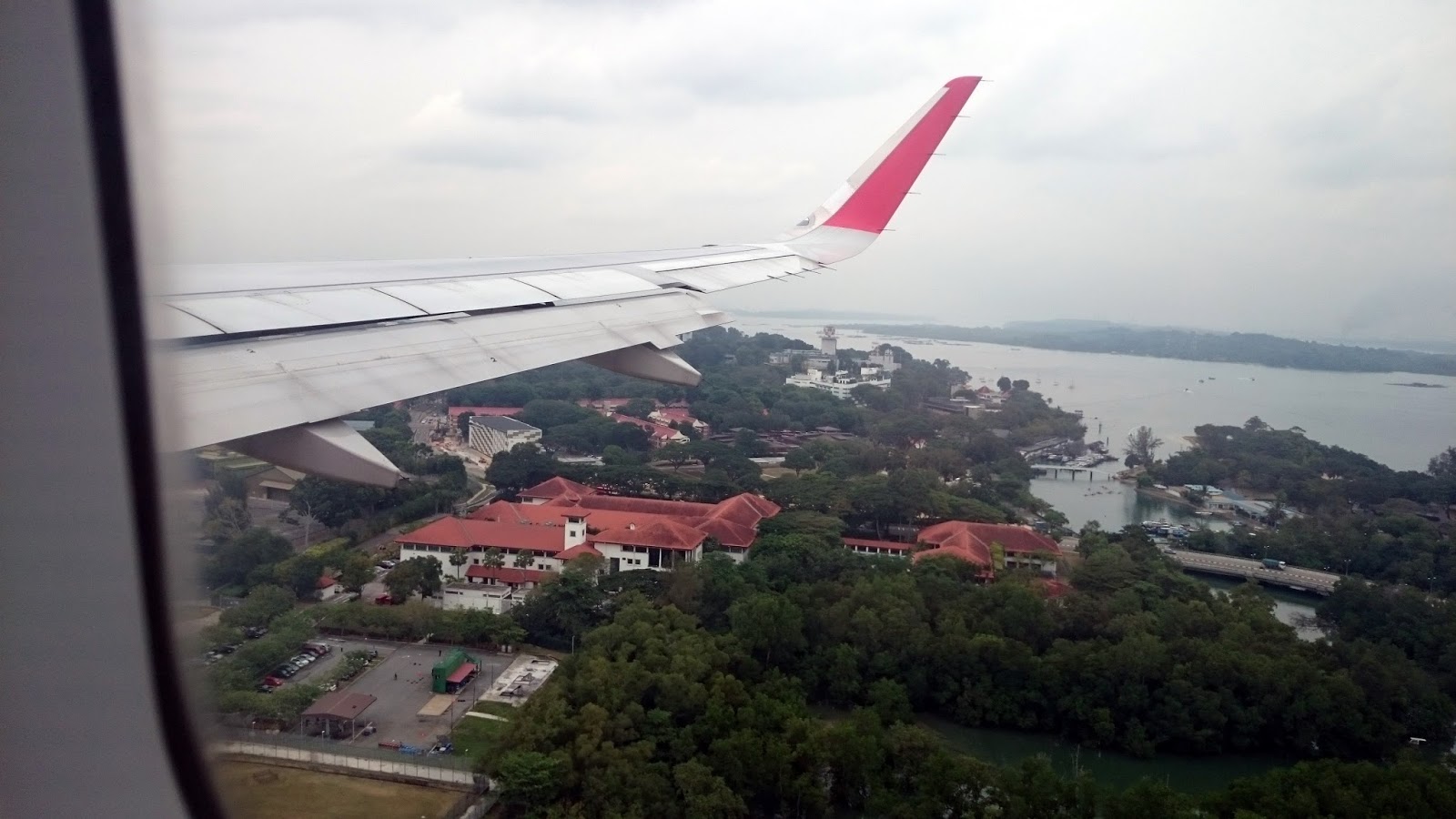
Pulau Ubin in sight.
Passing Changi Beach Park and Singapore Aviation Academy.
Landed runway 20R at 9.30am , vacated W7, left onto WP and was greeted by the sight of SIA's Dugong.
Landing video here.

Taxied past not one but two Dugongs in SG50 colors. What luck!
Right onto North Cross 3…
Parked beside Jetstar Asia 9V-SJ. Shutdown at 8.35am.

All in all the flight was pretty uneventful. And the fare for this flight was only RM39 per person! Can't say it wasn't a steal. Didn’t go for any inflight meal option due to the short duration of flight and we just had breakfast before boarding. During disembarkation, the captain was out to greet passengers. Our request for a cockpit visit was politely declined by the captain out of fears that we would be posting our pictures on social media which was understandable. However I did take the opportunity to thank him for taking us safely to Singapore and congratulated him on the greaser landing. 

Saturday, 18 October 2014

My First AirAsia Flight Attendant Interview Experience

To be honest, I was never too keen on becoming a flight attendant. My main goal was always to be in the front seat in the cockpit. But hey, gotta try something else once in a while right? It all started when I went with a friend to a job fair last month and there was an AirAsia kiosk. Apparently there were only 100 application forms available and those who brought their resume only needed to fill the form at the kiosk and were interviewed on the spot. But as always with AirAsia and their flight attendant recruitment, the forms got snapped up like hot cakes. We were told there was going to be a walk-in interview on the 18th of October and I made the craziest decision to go for it. We wanted to attend the interview for the experience since we were still in college and close to finishing our diplomas. So at least we have experience going to a job interview before we even graduate. I dragged my friend along and he was quite reluctant at first but as the 18th drew nearer, we were filled with nervous anticipation. But anyways I'm pretty sure you guys will want to know how it was, right? Keep in mind I'm a male and some procedures might be different from the ones you might have read on other blogs. There isn't always necessarily a specific procedure or question set.

For the list of requirements and the things that you need to prepare, please please refer to the AirAsia website or at FlyGosh.com

So registration was from 9AM to 11AM. Candidates are advised to be there early as the line may be quite long. Which it was. We arrived at Kuching International Airport at around 8:45 and the queue was crazy. I heard the total number of candidates was somewhere over a hundred people. And that is considered a small number.

First Stage
The first stage is the document and credentials check. They will check if you have brought with you everything that you need (Eg: IC, SPM cert photocopy bla bla bla). After that you will proceed to the height check (barefoot). Again, for the minimum requirements please refer to the AirAsia website. The minimum requirement is printed on the form too. If you are a few centimeters below the required height, they might pass you. MIGHT. Then you are given a number and you have to join a separate queue. There are two queues. One was for registration and the other is the one where you will join when you pass the first stage.

Second Stage
The second stage is the one on one interview. Since the AirAsia office in KIA is quite small, they will ask you to enter in pairs. Sometimes they will ask 4 people to enter to speed up the process. Once inside the office, there will be a holding place where you will wait for your turn. The interview took place in a small room. Totally different than what I expected. It was a small room with two tables set approximately one metre apart with one candidate per table. Behind each table are two interviewers. You will be asked to stand in front of the table. No sitting here. The questions they will ask you or the stuff they will ask you to do varies with each person. What you will be asked depends on the interviewer. For me they asked me to introduce myself, explain why I chose this position in this industry and what my hobbies were.
All pretty straight forward. There is really no telling what they will ask you so I suggest before attending the interview you read up on as many things as you can. For example the company's statistics, who the key people are, important achievements etc. After they are done asking you questions there will be a card on the table. You will have to pick it up and read the announcement scripts. They are in English and Malay, 2 different sentences. They might not ask you to read all of it. They asked me to read the English parts only. But that part is simple. Just make sure you articulate your words well and be calm. Make sure your words are loud and audible. After that they will give you feedback and probably point out things that you need to improve on.
Try not to give cliche answers. Map out your answers and make them stand out because within those few minutes in front of the interviewers, you really do need to impress them quick.

Please keep in mind they will not tell you whether you passed or failed on the spot. They will notify you via email in a few weeks' time.
And with that, it's over. It seems really quick when you go in but it might actually be quite long.

A few tips:
-those with glasses, get contact lenses. I did not see a single person with glasses on that day. If you have never used contact lenses before, make sure you get them at least a few days or maybe weeks before the interview. Get a feel of them and make sure you're comfortable with them on.
-make sure you are neat and please do not wear casual. at least wear something that is presentable. Treat it like a very important job interview. Which it is.
-make a checklist of the items required a few days before the interview. keep it all in an envelope or a folder and do double checks every night.
-for those who have pimples, try to cover them up especially if your pimples are glaringly obvious. they might check for facial scars too.
-trim your nails! they might ask to see your hands and fingers.
-make sure you are confident in your communication skills and take care of your personal grooming. they are really particular about that.
-SMILE! Be friendly and nice to everyone! Especially the ones handling your forms in the first stage. They might seem nasty and sarcastic but they are supposed to be because they are judging you from that very moment you make contact with them. They are judging your reactions and how you handle things even before the interview begins! And keep a look out for some staff walking around. They might be judging you too. Basically be nice and say hi to everyone even if you come across one of the crew in the toilets. I'm serious.

I hope that this post was helpful. If you have any questions you can comment and ask. But please do not ask about the requirements and all that. Do your own homework, put in your own effort. If you are afraid that you will not meet the height requirement but you still wanna try anyway, just go for it! Never try, never know right?

Thanks for reading :)

Thursday, 3 July 2014

Virtual flying? Virtual airlines? Virtual air traffic control? What?

So many people have dreamt of flying, me including. The feeling of soaring above the clouds with the shadow of your aircraft beneath you in the clouds. Yes, YOUR aircraft, piloted by you, with you at the commands. However for many very valid reasons, not everyone has the luxury to fulfill that dream. So those people turn to virtual aviation. Virtual aviation makes use of desktop flight simulators, an online aviation network and software developers who create addons to add to the level of realism in these flight sumlators. 

Some might think that desktop flight simulators are nothing in comparison with the real deal. Admittedly, that is the case. You cannot feel the same things you feel when you are up in the air with the sun in your face and feeling your stomach falling when the aircraft climbs. However, desktop simulation has reached a level so high that certain aircraft addons have been approved to be used for training purposes be it at home or for commercial simulation training. So when it comes to system simulations, you can be assured that the virtual aviator community has got that covered. 

That being said, I will show you in detail a flight operated by a virtual airline called Malaysia Virtual Airlines. MVA is not in any way associated with the real life operations of Malaysia Airlines or its subsidiaries. It does, however simulate operations of the aviation industry in Malaysia based upon the real world activities of Malaysia Airlines, Transmile Air Services, AirAsia, AirAsia X, Firefly, MASWings, MASKargo, Berjaya Air and Malindo Air. 


I fly for the AirAsia and AirAsia X portion of MVA and as such, I mainly fly the Airbus A320 and A330-300. Today we will focus on a popular domestic route, Kuching to Kuala Lumpur as flight AK5209. 

My pilot badge as of 3rd July 2014
MVA uses a flight tracking software which connects to Microsoft Flight Simulator X to track the VA pilots' flights in real time. The software is called mACARS and it records the flight profile and other details of the aircraft along its journey. 
So first before starting a flight I would start up FSX (Flight Simulator X) at the origin airport, set the aircraft up and connect to an online network called VATSIM which stands for Virtual Air Traffic Simulation. VATSIM is a network populated by virtual aviators such as myself. In VATSIM we have the virtual pilots and virtual air traffic controllers. The ATC follow real world operation procedures for the region/country they are in and it is really close to the real thing. We even have real world ATC logging onto VATSIM to help control the virtual airspace in their free time. The Malaysian side of VATSIM has its own batch of controllers servicing mainly Kuala Lumpur and Penang. However these controllers can switch to control at any airport they like.  For more information of VATSIM in Malaysia, the link is here. So at the end of the day, VATSIM is quite a professional environment to be in. More on that later.

The aircraft we will be flying today is an Airbus A320-216 registration 9M-AQR. All aircraft registered in Malaysia will carry '9M' in front of it followed by whatever code the operator chooses. The A320 is a short to medium haul passenger aircraft with a max seating capacity of 180 passengers. It has a maximum cruise speed of Mach 0.82 (which is 82% the speed of sound) and a maximum range of 3100 nautical miles. It uses the famous Fly-By-Wire avionics technology and has an excellent safety record all over the world.

So I load up the aircraft in a cold and dark state (with no electrical power and with engines off) and I prepare the aircraft for the journey. This phase of the flight mainly includes powering the aircraft up and setting up the flight computers with all the necessary information. 

The aircraft all powered up and ready to load cargo and passengers
Catering trucks have started loading. Note that the aircraft doesn't use the PBB (passenger boarding bridge) like in the real world operations in Kuching.
The aircraft registration can be seen here
At this time I will 'walk around' the aircraft and physically inspect everything outside the aircraft and check for any damages  

Registration is also under the wings
The cargo has arrived and is being loaded
After the walkaround is completed, I set up the flight computers for the route and wait for the boarding and loading to be finished. 

The MCDU (Multi Control Display Unit) being set up for the initial stages of route planning. 
 The route we will be using to KL is given by MVA which is:

KAMIN G334 SAROX

A flight plan route follows the format ORIGIN-WAYPOINT-AIRWAY-WAYPOINT-DESTINATION
In this case, the origin will be WBGG which is the airport code for Kuching International Airport and the destination will be WMKK which is the code for Kuala Lumpur International Airport. A waypoint is a set of coordinates that are given names to identify them easily and they can be considered as 'checkpoints' which pilots need to fly over in a route. An airway is like a highway in the sky used to get from waypoint to waypoint. In this case, KAMIN and SAROX are waypoints and G334 is an airway. Airways are usually denoted by a combination of a letter and numbers.

We are taking 8,480kg of fuel today. The total number includes the trip fuel, contingency fuel, reserves, taxi fuel, holding fuel and others.

So once we have everything set up and loaded, we can now push back from the gate and start our flight.
Contrary to what some people may think, aircraft do not have a 'reverse gear' or a 'drive' mode. That is not how they move on the ground. Aircraft move by forward thrust and reverse thrust. Reverse thrust are mainly used during the landing roll to redirect the flow to help slow the plane down. It is possible to use reverse thrust to move the aircraft backwards but there is always a danger of ground equipment damage, injury/death, foreign object and debris injection into the engines, not to mention higher fuel consumption. Therefore it is not practical to start the engines at the gate and reverse the aircraft from the gate using its own thrust. However smaller prop aircraft may use reverse thrust at the gate although it is still under the authority of the airport regulations and air traffic control for that manoeuvre.

Pushback commences at 7:59AM, one minute ahead of the scheduled departure time of 8:00AM.
Pushback is done using a pushback tug/tractor. The aircraft is positioned on the apron in a way that it is far from any ground crew or equipment for the safe start of engines.

Engine 2 (right engine) is started first followed by Engine 1. Both ECAM displaying the engine parameters that needs constant monitoring throughout the startup process.

Pushback tug has been disconnected and we are ready to roll!


Flight controls check. The ailerons on the right wing lifting.
The lower ECAM screen showing the flight control surfaces' deflections.
We will be taking off from runway 25 using the SID (Standard Instrument Departure) IGEVU1E. SIDs are predetermined routes that need to be followed by all outbound traffic flying IFR. It reduces the ATC workload and provides a more systematic flow of traffic away from the airport. 
Our V speeds for today's departure will be V1=148knots, VR=149knots and V2=150 knots with a flap setting of 1+F.

The IGEVU1E departure from runway 25. We will first climb out on the runway heading (248 degrees) and reach the MUPEP waypoint at or above 3100 feet. From there, we will turn right on a heading of 293 degrees and track direct to the IGEVU waypoint. From IGEVU, we will continue on to the first waypoint of our route. Note the M761 in the black box. That is another example of an airway.
08:11AM
Lined up on runway 25, slowly advancing the thrust levers for takeoff power.

Climbout. Goodbye Kuching! See you soon! :D

Gorgeous Kuching scenery
Climbing to our cruise altitude of 36000 feet, tracking the IGEVU waypoint on a heading of 293 degrees just like in the SID chart, thereafter to our route's first waypoint KAMIN. The blue arrow on the right hand side display (ND-Navigation Display) denotes the top of climb, a point in which we transition from the climb phase to the cruise phase.
The captain's sliding tables. No traditional yoke or 'steering wheel' here. Airbuses are flown using a sidestick.
Passing Gunung Rumput and the town of Lundu. The view in real life is even more breathtaking. If you bother to look out and appreciate it. 
Leaving Borneo at 27000 feet
Reaching out cruise altitude

Tracking my flight. On the radar you can see other pilots around. Those are all virtual pilots in the air doing the same thing we are doing right now. Flying in the virtual skies! :) Over at Peninsula Malaysia, you will see it is covered in a blue shape. That is the Malaysian airspace (Peninsula side) also known as Lumpur Centre. When you see this, it means that there is an air traffic controller on VATSIM controlling that airspace. Over at WMKK (KLIA) you will see D,G,T,A. Those are Delivery, Ground, Tower and ATIS. Those stationed are manned by different people for each station and they control certain parts of the airport (such as ground movements and takeoff/landing clearance) and airspace. Once I cross into the blue boundary, I am required to contact the controller for Lumpur Centre. He will give me a transponder code to squawk so he can identify me on his radar. From there he will give me clearance to KLIA and also issue me descent instructions. At a certain distance from the airport, I will be handed over to Tower who will give me my landing clearance and once the runway has been vacated, I will be handed over to Ground for my instructions to the gate. Just like in real life :) ATIS stands for Automated Terminal Information System and it gives me information regarding the airfield such as the weather, cloud bases, temperature, runways in use etc.
After cruising for a little over an hour, I am given my descent instructions and arrival information. I am given the LENK1A STAR via SAROX transition. STARs (Standard Terminal Arrival Route uses the same concept as SID, just that STARs are for arrivals). I am instructed to descend from 36000 feet to 13000 feet. 

Choosing the ILS runway 15 approach. Runway 15/33 is the new third runway built for KLIA2 operations recently. As we are an AirAsia flight, I am given runway 15. Runway in use is usually determined by the wind direction as aircraft should land and takeoff into the wind.
Selecting the SAROX transition. As SAROX is the last waypoint in my route, I will transition from SAROX into the LENK1A arrival.
Entering the arrival information. The final approach speed is calculated by the computer which in this case is 137 knots.
Descending into KL.
And from SAROX we go to LENKI (that is why the STAR is called LENK1A). Note in magenta there are numbers next to the waypoints. Those are speed and altitude restrictions. At LENKI we should be at or above 10000 feet at a speed of 250 knots. At KIDOT, we should be at or above 6000 feet with a speed of 210 knots. A pretty straight forward visualization of the approach path to the runway. 

Autobrake setting on LOW. Runway 15 is long enough with dry conditions so I don't need that much braking power.
Banking right to join the circuit
The blue line of the route is the missed approach line. In case the landing has to be aborted, this is the route I have to follow before being given instructions by ATC to rejoin the pattern for approach.
Speedbrakes deployed to help us slow down
Gear going down
Flaps in full configuration for landing
Runway 15 ahead. On the left is runway 14R
Touchdown at 9:38AM, spoilers up! These panels are also called 'lift dumpers' because they 'spoil' or 'dump' the lift from the wings, allowing for more drag
Nice solid thud onto runway 15
After vacating the runway, I am handed over to Ground traffic control and was told to taxi to any gate at my discretion. I chose gate J2. In real life operations, AirAsia operates domestic flights from the J and K apron of KLIA2. 

Follow-me car to the gate. KLIA2 apron and taxiway operations still need getting used to for me. Follow-me car and at the gate services provided by an addon called GSX (Ground Services X). I recommend you to get it to add a nice touch to your ground movement in airports.
Passengers disembarking via jetway just like in real life KLIA2. Baggage unloading at the same time.
On block time: 9:49AM


With a total amount of fuel used at 4200kg, we have safely arrived at our destination. That concludes the 1 hour 38 minutes flight and I hope you enjoyed everything. Feel free to ask any questions in the comments section. 

DISCLAIMER: FOR USE IN FLIGHT SIMULATION ONLY. THIS POST DOES NOT REPRESENT THE COMPLETE OPERATIONAL PROCEDURES OF AIRASIA AND ITS AFFILIATES IN REAL LIFE 

All in all, I hope this gives you enough information to satisfy your curiosity as to why some people spend hours in front of their computer 'playing' a 'game' like this. I strongly disagree when someone calls Microsoft Flight Simulator X a game. The level of realism keeps growing over time and people do it out of love for aviation. Some treat it as a hobby or a passion satisfied by alternative means. Some just like the fun of flying an aircraft and to be able to simulate emergencies and failures without actually endangering their lives. I apologize if this post has been too long. I did try to keep it short >< Perhaps I will write another post like this but from a different perspective. Perhaps. Till then thanks for reading and happy landing always!